
Prices increase March 2 — order now to lock in current pricing.
Every day we get asked about common window film myths – sometimes multiple times a day. So we are debunking persistent window film mythis in this artcle to help consumers better understand window tint and what it can do for your home.
Window film has come a long way over the past few decades. Today’s residential window films are more advanced, more durable, and far easier to install than many homeowners realize. Yet despite these improvements, a handful of persistent window film myths still cause hesitation for people who could greatly benefit from window tint in their homes.
In this article, we’re debunking three of the most common window film myths we hear from homeowners every day. Whether you’re researching window film for heat control, UV protection, or privacy, understanding the truth behind these misconceptions can help you make a more confident and informed decision.

The myth:
You aren’t supposed to install window film on double pane windows.
The reality:
You can safely install window film on most double-pane windows—as long as the film is properly designed for residential glass.
What is a double pane window? A double pane window is a type of energy efficient window that became popular in the United States in the 80s in response to the energy crisis of the 70s. The windows are comprised of two panes of glass separated by a spacer. The resulting space created between the two panes is filled with an inert gas like argon to create insulation from the elements. Today, double pane or dual pane windows are the norm for most new build and replacement windows.
Modern residential window films, especially ceramic and spectrally selective films, are engineered to manage solar heat without creating excessive thermal stress on insulated glass units (IGUs). Older generations of dark or highly reflective films were more likely to absorb heat, which could increase the risk of thermal cracking. That history is where this myth originated.
To read more about window film and double pane windows, please see our deep dive on the topic.
Today, reputable manufacturers test their films specifically for compatibility with double-pane and low E windows. All of our films are rated for use on double pane windows up to 40 square feet in size.
The key factors that matter are:
Film type (ceramic vs. dyed or metallic)
Visible light transmission (VLT)
Solar absorption vs. reflection
Installation on the interior surface
According to the International Window Film Association (IWFA), properly selected window film can be safely applied to most residential glass types, including double-pane windows, without increasing the risk of damage when manufacturer guidelines are followed.
Bottom line: Double-pane windows are not a dealbreaker. With the right film, they’re actually one of the most common and successful applications.
The myth:
Window film installation is too technical for homeowners, and DIY installs always look bad or fail prematurely.
The reality:
While professional installation is a great option for many people, it is absolutely possible for homeowners to achieve professional-looking results with DIY window film—especially with Concord Window Film’s pre-cut kits and installation resources.
Our DIY window film kits and installation tool kit are designed specifically for homeowners and provide:
Pre-cut or custom-cut film sized to your glass
Step-by-step written instructions and installation video instructions
U.S. based customer support if questions come up during install
Installing window film is more about patience and preparation than technical skill. Cleaning the glass thoroughly, using enough installation solution, and taking your time and using the right amount of pressure during squeegeeing are far more important than having prior experience.
In fact, many homeowners successfully install window film on:
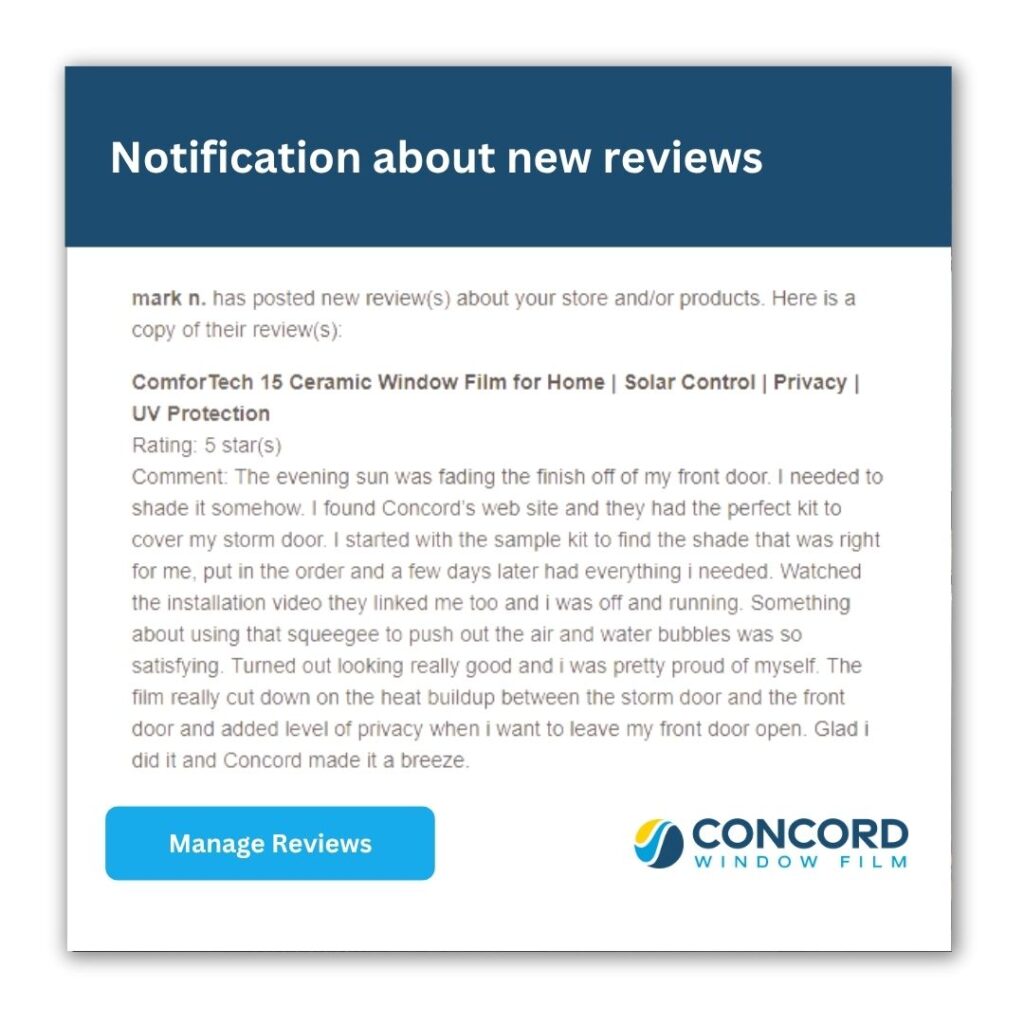
Storm doors
Front door sidelights
The U.S. Department of Energy even highlights window film as a homeowner-accessible upgrade for improving energy efficiency and comfort.
Thousands of customers have installed Concord Window Film successfully themselves on their doors and windows. Below is a sampling of real reviews from customers who have installed Concord Window Film:
“The film went up smoothly, and the process as a whole was simple — we even took a little pride that our “first timer” attempt could look so professional.” – Teri, AZ
“Great product! Installation was very easy. The installation kit has everything needed.” – Luke, CA
“Installation went very well in part due to the quality of the installation kit. Would recommend.” – Brian, NY
“Very easy to install and love that it is keeping sun out and that no one can see in the front door” – Cindy, TN
“Follow the very through installation instructions and it was a simple and easy process!” – David, TX
Bottom line: You don’t need a professional for every installation. DIY window film is a realistic, cost-effective option for many homeowners when quality materials and clear instructions are used.
The myth:
Privacy window film stops working at night, making it useless after dark.
The reality:
This myth is partially true—but often misunderstood.
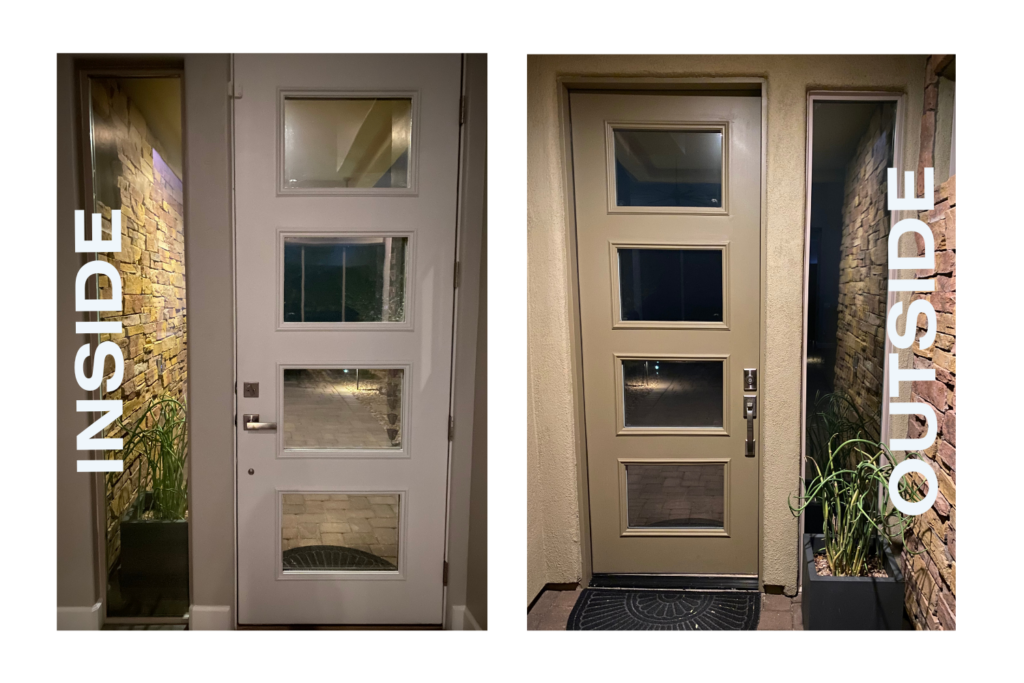
Reflective and one-way privacy window films work based on light balance. During the day, when it’s brighter outside than inside, the film reflects exterior light and limits visibility into the home. At night, when interior lights are on and it’s darker outside, that balance reverses and visibility can increase.
However, this does not mean privacy film is useless.
Privacy window film is extremely effective for:
Daytime privacy without blocking natural light
Maintaining outward visibility during daylight hours
Reducing glare and heat while preserving views
And in certain discrete situations, you can create night time privacy with transparent film using these strategies:
We had a customer in Arizona who was able to create night time privacy with our ComforTech 15 film for her entryway. She was so pleased, she wrote an entire testimonial with photos when we asked for a review of her purchase! You can read about her installation and see before and after shots here: Arizona Privacy Case Study.
At night, privacy film is best used in combination with blinds, shades, or curtains. Many homeowners prefer this layered approach because it allows them to enjoy open, sun-filled spaces during the day without feeling closed in, then add privacy at night when needed.
There are also non-transparent privacy films—such as frosted, matte, or decorative films—that provide 24/7 privacy, regardless of lighting conditions. These are ideal for bathrooms, entry doors, sidelights, and street-facing windows. Concord Window Film has an opaque film called Matte White Privacy film that provides day and night privacy. The film mimics frosted glass, obscuring views, but letting in a lot of natural light.
Bottom line: Privacy film works exactly as designed. Understanding how it works allows you to choose the right type of film for your needs rather than dismissing it entirely. Learn more about privacy film with our complete guide here.
Window tint is one of the most versatile and cost-effective upgrades you can make to your home—but outdated window film myths often stand in the way. The truth is:
Double-pane windows can safely accept modern residential films
DIY installation is realistic for many homeowners
Privacy film is highly effective when chosen and used correctly
By separating fact from fiction, homeowners can confidently use window film to reduce heat, protect furnishings from UV damage, improve comfort, and enhance privacy—without unnecessary fear or confusion.
If you’d like help choosing the right film for your specific windows or understanding which option best fits your goals, reliable educational resources and manufacturer guidance are always the best place to start, and our website has a lot of resources. And if there are other window film myths or any question we can answer – please don’t hesitate to reach out to us: 888-206-1413, support@windowfilm.com or through the chat bubble in the bottom right of our site.