

Wondering how to choose window film for your home? Not sure where to start?
Choosing window film for your home can feel overwhelming at first—there are different film types, performance numbers, shade levels, and aesthetic considerations to weigh. The good news is that once you break the decision down into a few clear steps, choosing the right window film becomes straightforward and confidence-building.
At Concord Window Film, we work with DIY homeowners every day who want professional-grade results without guesswork. This guide walks you through the same decision process our customer support team uses, so you can choose window film you’re your home that solves your problem and looks great in your space.
Before looking at shades or performance charts, start with the most important question:
Most homeowners consider installing window film when they have one (or more) of the following concerns:
We’ve broken these down in detail in our guide on the issues homeowners are solving with window film, which explains how different films address each problem and what tradeoffs to expect.
👉 Learn more here: https://windowfilm.com/issues-homeowners-are-solving-with-window-film/
If you want a faster, guided option, we also offer a short product recommendation quiz that matches your issue with the right film type in minutes. Just answer a few short questions and we will provide the film that will best address your needs.
Once you know which type of film you need, the next decision is shade.
If you’ve gone through the product recommendation quiz, you know that in most situations you will be offered a selection of a few different shades of our ComforTech that can help you achieve your results.
The question becomes, which shade do you prefer? This is where performance and personal preference intersect.
For solar control films, darker films generally provide stronger heat and glare reduction. As visible light transmission (VLT) decreases, solar energy rejection increases—meaning:
The main metrics for solar control are Solar Heat Gain Coefficient (SHGC) which is defined as the amount of solar radiation that enters a building through its windows, doors, and skylights. It represents the fraction of solar heat gain that is transmitted through the glazing and absorbed into the building’s interior. The lower the SGHC number, the better the film does at blocking the sun. The National Fenestration Rating Council is the rating agency for window film (and windows) and uses SHGC as its main performance metric.
And it’s counterpart, Total Solar Energy Rejected (TSER). TSER is a measure of the amount of solar energy prevented from entering a building through its windows. It quantifies the window film’s ability to block solar radiation, including both visible light and infrared heat. TSER is expressed as a percentage, representing the proportion of solar energy that the film reflects or absorbs rather than transmitting into the interior. The higher the TSER, the better the film does at blocking the sun.
Here are the relevant specs for every shade of our ComforTech™ Ceramic Series film. You can see that the darker the film gets, the higher the TSER and the lower the SHGC:
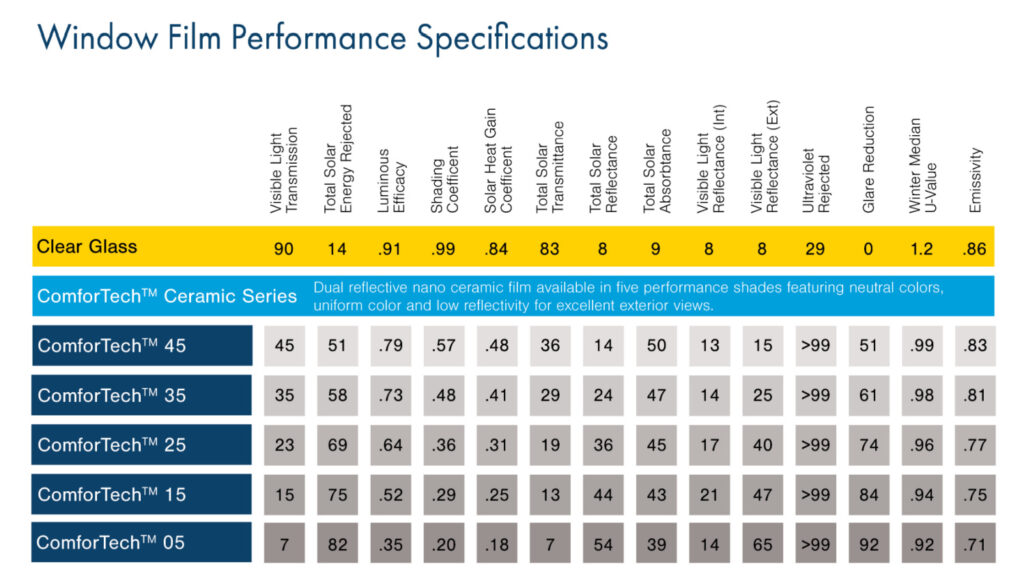
UV protection, however, remains consistent across shades. Whether you choose a lighter or darker film, UV rejection stays the same at >99% of UV in the 300-380nm spectrum when applied to glass. This is because the UV blockers are built into the adhesives in the film and are independent of the shade of the film. This means all of our films protect people, furnishings and flooring from harmful UV rays.
You can see exact performance numbers—including VLT, heat rejection, and glare reduction—on the ComforTech™ Ceramic Series performance specs page. And for definitions of all the specs, please refer to our Window Film Terminology page.
Another important consideration is the exterior reflectivity of the film.

Window film works by reflecting a portion of the sun’s rays AND absorbing a portion of the sun’s rays to lower the solar energy that enters your home. (Learn how window film works). The darker the shade of our film that you choose, the more exterior reflectivity it will have.
In fact, starting with our ComforTech™ 25, there is enough exterior reflectivity to offer daytime privacy in addition to solar control.
So if you absolutely do not want a film that looks reflective to the outside, you would want to stick with the lower VLT shades of ComforTech 45 and 35. If you are OK with more reflectivity to gain more solar control or you explicitly want privacy, you would choose from the darker shades of ComforTech™ 25, 15 or 05.
Shade choice is also a visual decision. Some homeowners prefer a barely-there look that preserves maximum natural light, while others like a darker, more modern appearance. In some cases, HOA rules may limit exterior reflectivity or darkness.
There’s no universal “best” shade—only the shade that works for your home, your lighting, and your comfort level.
One of the most effective ways to choose confidently is by ordering a sample kit. Our sample kits include all five ComforTech™ film shades from the same series, allowing you to:
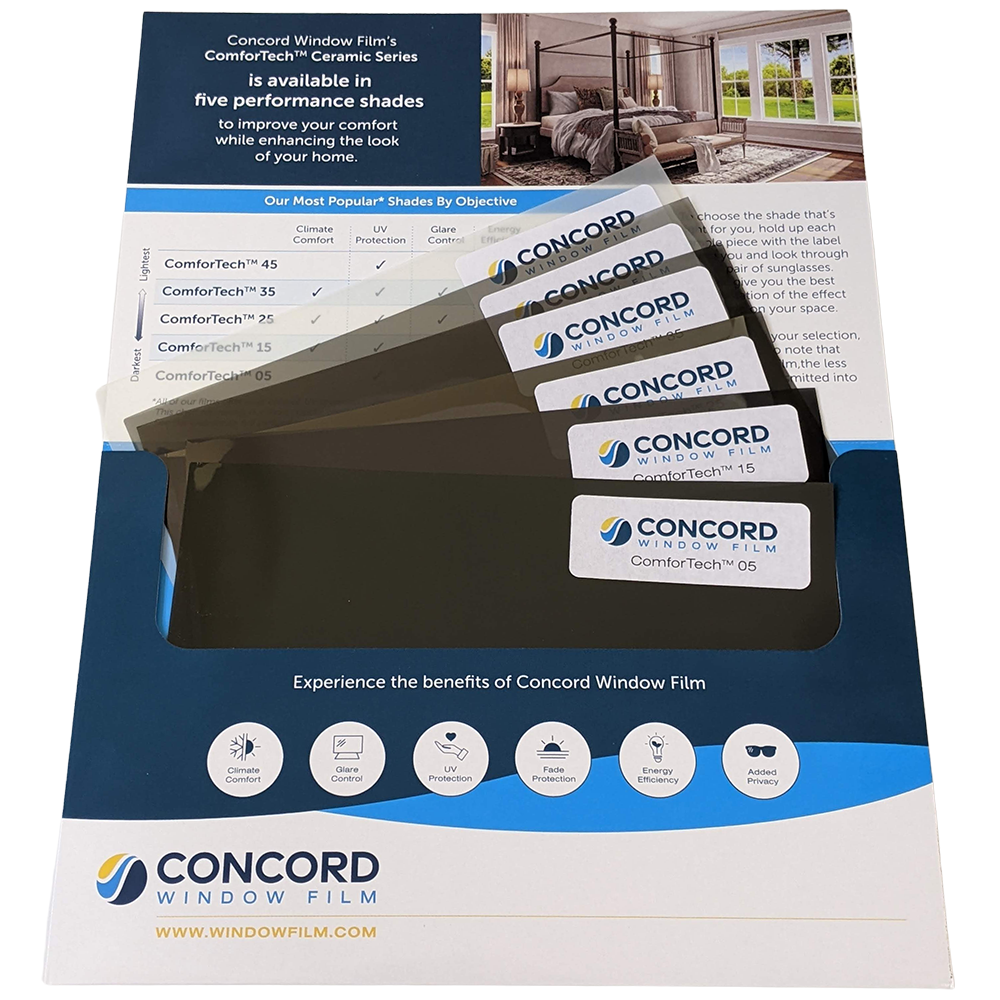
To use the samples, simply tape them to the interior of your window and observe how each shade changes the room throughout the day. This real-world test often makes the decision instantly clear.
Even with clear steps, it’s completely normal to want reassurance—especially when you’re upgrading your home.
Our U.S.-based customer service representatives are here to help you choose with confidence. We can:
You can call us (888-206-1413), email us (support@windowfilm.com), or chat with us directly on the site (thru the chat bubble in the bottom right hand corner) —whatever’s easiest for you. Our goal is simple: help you get the right film for your space so you’re happy with the results long after installation.
Choosing window film is about more than just performance numbers. The right film should solve your problem and enhance the way your home feels and looks every day.

You can achieve the results you are looking for and setting yourself up for success by:
Window film is a lasting upgrade. Taking a little extra time upfront ensures you get the comfort, protection, and appearance you’re expecting. And if you ever need help along the way, we’re here.
